Postal Stamps, Labels, Envelopes, Postcards, and whatever else that can give us an excellent opportunity to examine the conflict through contemporary items in the participant's daily lives. I am not a partisan of either side of the conflict, but just a curious neophyte.

Tuesday, July 31, 2018

Rust-not just a Canadian Crayola color from 1987

In 1987, Crayola produced for the Canadian market a set of metallic crayons-which included the color Rust.

This post isn’t about that, what it is about is the “rusting” of stamps and envelopes, also known as foxing. I knew about foxing from my experience in the way back-but rusting is new to me. This is the process by which a stamp or cover is attacked by mold and funguses. This can turn the stamp/cover various colors (orange, black, green, and blue) and is usually as a result where the items were located and stored and how humidity affected the items. Here are two images of a stamp and of a cover with rust.
I have only been aware of the orange and the black spots. The mold and fungus attacks the glue etc. and will make the item worthless. As I dove into the hobby I picked up just a few items that had significant or faint rust. I destroyed them-a couple of covers I put aside and I reexamined and I can’t determine if it is rust or a stain and I will need an UV light to do so-so I have placed them in plastic non-acid sleeves and isolated them from collection for further observation. These images really give you an idea of what to look for-fairly easy to do so.
While no stamps were involved I did lose some stamps on cut paper and covers. I am bummed but thankfully it wasn’t much and a lesson learned. So what were the lessons learned?

1. If a cover is listed that has interesting franking and bidding is slow to nonexistent-it is probably because there is rust, or another fault.

2. Use the zoom on the Bay to examine every inch of the cover or stamp that is listed.

3. Don’t be afraid to pass on something if you detect what you think is rust unless you get it for dirt cheap and you can examine further to determine if rust or not, and if it is you aren’t out of much $$. If it isn’t, rust then you picked up a steal.

4. Spanish covers seem to be hit hard-again from the environment.

Here is one cover I destroyed-really broke my heart as I loved the franking.
I have read various posts and threads on whether to remove the rust or not-and I understand both sides, but as some have pointed out the issue is when these cleanings are not disclosed when the item is sold off. For me, I am not going to remove any as I threw them out. Could you freeze them to stop the fungus/mold? Probably just end up with a soggy piece of paper.

Saturday, July 28, 2018

“Thank you. Thank you so much, for everything.”

This is a line from the movie Cinderella as the topic of this post are cinderella stamps issued by the North American Committee to Aid Spanish Democracy. Issued during the war were five labels issued to raise funds and awareness of the Republic's cause. I won two of the five this week. The first one I picked up, and the first known to be issued is a Christmas label "Christmas Greetings" and "Help Spain's Children" with an image of a mother carrying a dead child. A little departure from the initial season's greetings.
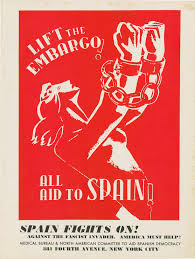
The committee was located in Brooklyn at 38 4th Ave and was made of ethnic and labor groups that raised money, food, and supplies for the Republicans. Unsurprisingly, this was a Communist front group with links to the Communist Party U.S.A. The organization funded an ambulance, and medical care for the war as well as gave lectures and produced various literature to bring information to the public.

issued in 1939, the third set of labels issued were also very well designed and very compelling. These are the two I Gave that Spain's Children May Live. Two stamps issued in 5c and 25c values were for fund raising. The 5c was blue with a 11 3/4 perf and the size was 5x4 mm. While the larger (44X51 mm) 25c was red and designed to be placed on back of envelop. We won the 5c one. Both stamps feature a crying toddler with "I Gave That Spain's Children May Live", "North American Committee to Aid Spanish Democracy".

There is also two more, one "Christmas Aid for Spanish Refugees", no value and was black on orange paper. There was also a pin that went with the stamp.
The second stamp was issued in 1937 by the Motion Picture Artists Committee Hollywood "Give to a Spanish Child", perf 12, no value, and red and green graphics. Wonder how many of these folks were later blacklisted? At the conclusion of the war the committee disbanded.

Tuesday, July 10, 2018

Pan's Labyrinth (El laberinto del fauno “The Labyrinth of the Faun') (2006)

Written and directed by Guillermo del Toro.
During the Summer of 1944 just five years after the end of the war Ofelia, a young girl whose mother is married to a Falangist officer, floats between the real word and a mythical one in which The Faun assigns her several missions that he says are to make sure she reigns over her kingdom.
Ofelia’s stepfather is hunting down the local resistance and since I haven’t watched any movies that address the fighting after the war between the Spanish government and Falangist and the resistance. I thought this was fascinating and look forward to seeing more movies on this subject.
The aforementioned Ofelia is lead by the Faun through his labyrinth garden on these special missions. During which she encounters several magical beings, fairies, giant toads, and a creature with eyes in his hands. As a fan of the TV show Faceoff I really enjoyed the make up and effects. Doug Jones who has been a guest judge in the show plays the Faun.
No Stranger to allegorical and fairy tale movies about the Spanish Civil War. This is Del Torros’ second film on the subject, the first being The Devil’s Backbone (2001). Del Torro says that Pan’s is the spiritual successor to The Devil’s Backbone.
Ofelia, the Faun tells her, is Princess Moanna whose father is the king of the underworld and that there were several portals in which her spirit was sent and at which he built his labyrinths waiting for her to return. These tasks are designed to bring her to her rightful throne. Not going to give you any spoilers-but I will say there is enough sadness to go around.

There is intrigue, violence, sadness, and magic. I really enjoyed the film, I wasn’t sure I would because I am no fan of fantasy films.

What a beautiful film, the special effects, the cinematography, and the story.

Sunday, July 8, 2018

Ufficio Postale Speciale #4- July 13th, 1937

I have been looking for the areas where the locations of the various Ufficio Postale Speciales were. When mean looking I really am referring to Goggling. I have not bee able to locate then. But nonetheless we march on.
This letter was mailed on July 13th, 1937 from Angelo Bianchi of the 724th Bandera "Inflessibile", 2nd Company, 7th Gruppo, “Fiamme Nere” (Black Flames) Poste Speciale 4 (500) to the family of Luigi Bianchi in (Urgnano) Bergamo via aerea I can actually read Italian pretty well but there is one word I struggled with but looking at the Wiki entry for the Order of battle for Guadalajara the Console of the 7th Gruppo was Marino Marino. In my “search” I haven’t found out anything out about Angelo Bianchi. What happened to him? I wish I knew. The cover is stampless and has a nice patriotic slogan. I can't read the word in the top right corner.
So the letter was written after the disastrous Battle of Guadalajara.The Division XXIII di Marzo were part of the 2nd CCNN Division which was filled out with the disbanded 3rd CCNN Division (April, 1937) following their loses from the Battle of Guadalajara. Then from April-August of the same year the CCNN Division began to take on a different composition with Spanish troops being the foot soldiers while the Italians were the technical and officer component.
More changes for the Division XXIII di Marzo when in October following the ending of the Northern campaign they along with the 1st CCNN Division were consolidated with the Division XXIII di Marzo and renamed the XXIII de Marzo - Llamas Negras Division.

Order of battle for the Battle of Guadalajara 1937

2nd CCNN Division "Fiamme Nere" - Bgd. Gen. Guido Amerigo Coppi

6th Group of Banderas - Console Mario Pittau.
-651 Bandera "Ardita" - Seniore Spagnolo
-630 Bandera "Intrepida" - 1st Seniore Angelucci
-638 Bandera "Audace" - Seniore Alberto Zaccherini
 Support Battery 65/17
Engineers Section

7th Group of Banderas - Console Marino Marino
-724 Bandera "Inflessibile" - Seniore Gamberini

But before the August-September 1937 Battle of Santander which was a decisive victory for the Nationalists. Following this the Fiamme Nere were transferred to the Aragon front.The Division XXIII di Marzo performed very well in the Aragon offensive, which began March 1938. The Fiamme Nere led the break through of Republican‘s lines which led to the eventual ending of the war as Barcelona, the objective, would fall January 26th, 1939.


(Incomplete) Order of battle for the Aragon Offensive 1938

Commander: Luigi Frusci

IV Grupo de banderas

V Grupo de banderas

VII Grupo de banderas
-Battalion Implacabile
-Battalion Inflessibile
-Battalion Disperata
-Battery of 65/17

Sunday, June 24, 2018

Let Us Play Can You Spot the Difference?


As I sit here while waiting for my Edifil catalogue to arrive I  have been flipping through the SG Portugal & Spain Specialized. In doing so it has really been interesting to take note, literally, of the different perf, color, and printing differences of the various 2nd Republic and Nationalist issues.

One of which is Edifil #834 Holy Year 30 Cent Jacobus of Compostela. There are two versions of the 834s. One has no dots before and after 1937 (1st image) and the second type with a dot after and before the 1937 (2nd image).
Gibbons tells me the second type is more rarer  than the first. I thought I would see if I could find the second version on a cover. Alas, I came across one that isn't in the condition I would normally pick up for the collection and I would not even take a second look at this cover. However, I noticed there was a pair of the 834s. A closer look indicated that the pair is a Type I AND a Type II! I don't really know how special this is, or if it is. Sent on about September 25, 1937 from Bedun, Huescra, Aragon to Paris. Purple stamped "VISADO POR LA CENSUR" and I can't make out the town. Franked with a pair of the 834s, I wish they were right side up-but I will take it, and I will be on the hunt for more!

Thursday, June 21, 2018

Italian Corps of Volunteer Troops (Corpo Truppe Volontarie, CTV)

I am fascinated by military history, well all history, since as long as I can possibly remember. As most readers know the military units in the war consisted of a wide array of nationalities, geographic originations, politics, and religious and non-religious participants. One group that made up the military forces of the Nationalists was the Italian Corps of Volunteer Troops (Corpo Truppe Volontarie, or CTV for short). Which was a mix of regular Italian troops and Blackshirt fascists.
I think since this is the first post on the CTV I a little background on the Corp is warranted. After the rebellion broke out the Mussolini offered assistance as did Germany and on September 3, 1936 Italian bombers bombed Madrid to show the power of Italy and Germany. However, it wasn’t until Franco’s failed offensive against Madrid December 12th, 1936 that it was determined by Mussolini that Italian regular troops were needed for the war. On December 23rd, 1936 3,000 members of the “Italian Army Mission” arrived a Cadiz. However, come January 1937 there were about 44,000 Italian regular Army and Blackshirt Fascist paramilitary in Spain and by March 1937 there were 50,000 Italians in Spain.

Now designated Corpo Truppe Volontarie (CTV) the force was organized into four divisions; 4th "Littorio" Infantry Division (Lictor) - A fully motorized infantry division of the Italian Royal Army (Regio Esercito), 1st "Dio lo Vuole" Blackshirt Infantry Division ("God wants it"), 2nd "Fiamme Nere" Blackshirt Infantry Division ("Black Flames"), and the 3rd "Penne Nere" Blackshirt Infantry Division ("Black Feathers"). The Blackshirt Divisions AKA Camicie Nere (CNN) contained both regular army and Blackshirt paramilitary members.
Battles and campaigns of the SCW the CTV participated in were:

1937

The Battle Of Malaga (3 February to 8 February): Decisive Nationalist victory. Italian casualties were about 74 killed, 221 wounded, and two missing in the battle.
Fourth Madrid Offensive and Battle Guadalajara (8 March to 23 March): Decisive Republican victory. Italian forces suffered heavy losses, which resulted in the 3rd CCNN Division being disbanded and consolidated with the 2nd CCNN Division in April 1937.

April to August: According to Wiki “As the CCNN Divisions were reduced, Italians began to serve in mixed Italo-Spanish Flechas ("Arrows") units where the Italians provided the officers and technical personnel, while the Spanish served in the rank-and-file. The first were the Flechas Azules (“Blue Arrows”) Mixed Brigade and the Flechas Negras (“Black Arrows”) Mixed Brigade that served respectively in Extremadura and Viscaya from April to August 1937. Also in Viscaya were the CTV's XXIII de Marzo Group and 11 Artillery Groups.”

Battle of Santander August to September: Decisive victory for the Nationalists.

October: After the northern campaigns, the 1st CCNN Division and 2nd CCNN Division were consolidated with the Division XXIII di Marzo and renamed the XXIII de Marzo - Llamas Negras Division.
1938

Aragon Offensive and the March to the Sea March: The Flechas Negras Brigade was expanded and became part of the Flechas Division "Arrows"

November: The Flechas Division was strengthened and renamed "Flechas Negras" and the Flechas Azules Brigade was expanded into two other Flechas Divisions that took part in the Catalonia Offensive which was the final offensive of the war. Now there were the Flechas Negras Division "Black Arrows", Flechas Azules Division "Blue Arrows", and the Flechas Verdes Division "Green Arrows".
1939

February: Following the Nationalist victory the Italian volunteers withdrew from Spain.

Loses for the Italians during the war, out of a total force of 78,500, were 2,989-3,819  killed and about 12,000 wounded. The majority of these were from the Catalan and Aragonese Offensives.

Though deaths are of course hard for a nation the financial cost of the war was devastating for the Italians with 14-20 percent of their annual expenditure being used during the war. Alas, one would think this would have been a lesson but as we know it wasn’t.

Stay tuned for the second part of this post where we look at a piece of postal history and delve further into the CTV.

Wednesday, June 13, 2018

Ricardo Martinez Aviaciones Militar de Republica

A cover I picked up a few weeks ago was a cover from a member of the Spanish Republican Air Force. I have tried to locate more information on him but I have been unable to do so-I would assume that he wasn't an officer since I think it would have been indicated on the sender's information. The cover was sent by Ricardo Martinez on August 25th, 1936 from Madrid (Getafe) to a Maria Luz Martinez Vela in San Juan Puerto Rico. Franked with a 30c Jovellanos and a purple censurada stamp. Ricardo sent this from the Republican Air Force base at Getafe just outside of Madrid. Translated, Escradillo de Caza means Hunting Squad. Though I was unable to locate any information on Ricardo, the 2nd Escadrillo de Caza saw much action in the defense of the Madrid sector
This is a really good website http://surfcity.kund.dalnet.se/scw-1936.htm that has a run down of the Escradillo's actions in the Madrid sector (below).
The squadron was equipped with the French Nieuport 52 C1s.


25 July 1936-

Cabo Roberto Alonso Santamaría of Grupo de Caza No 11 forced a Breguet XIX to land at Grajera airstrip. At the time he was flying a Ni-H.52.

Urtubi Ercilla was promoted to the rank of alferez and posted to Grupo de Caza No 11.

6 August 1936-

Cabo Rafael Peña Dugo of the Grupo de Caza No 11 (Ni-H.52) attacked friendly Ni-H.52s that had taken off from Barajas. Sargento Andrés García La Calle suffered a buttock wound, but escuadrilla CO, capitán José Méndez Iriarte, crashed in enemy-held territory and was killed.

2 September, 1936-

Teniente Ramón Puparelli Francia of Grupo de Caza No 11 targeted the village of San Rafael, in Segovia, flying in a Breguet XIX.

Later teniente Puparelli accompanying capitán Manuel Cascón, in a D.372 and claimed a He 51 over the Madrid front. This earned Puparelli promotion to capitán, and he was also made CO of all Republican fighter units on the Madrid front.

13 September 1936-

A patrol of Aeronáutica Naval Vickers Vildebeests arrived at Getafe from Los Alcázares to reinforce the surviving Breguet XIXs of Grupo No 31. Heading for the Talavera de la Reína front, and escorted by two Ni-H.52s flown by teniente Félix Urtubi Ercilla (a former Nationalist pilot) of the Grupo de Caza No 11 and auxiliary naval pilot Carlos Colom Moliner, the Vildebeests were intercepted at dawn by three CR.32s led by capitán Joaquín García Morato and including Sergente GianLino Baschirotto and Sergente Vincenzo Patriarca.

The bombers managed to escape but Baschirotto quickly shot down one of the Ni-H.52s. The
27 September 1936-

During alférez Rafael Peña Dugo’s (Grupo de Caza No 11) second sortie six Republican fighters escorting a Potez 540 were attacked by five CR.32s led by capitán Ángel Salas Larrazábal, who chased the bomber. Sergente Manlio Vivarelli shot down the D.372 flown by alférez Peña, who bailed out with a leg wound. It is possible that British pilots Vincent Doherty and Eric Griffiths were also wounded during the same combat, although both managed to fly their D.372s back to Getafe airfield.
Peña was initially treated at the hospital in Toledo, before being evacuated to Madrid just prior to the provincial capital falling into enemy hands. His wound eventually became gangrenous and his leg had to be amputated.

There is a really good book on the Republican Aces-Osprey Aircraft of the Aces series by Rafael A. Permuy Lopez, whom also wrote a book about all the Republican Pilots. I wish I could see a copy to see if Ricardo was there-and what is the connection with Puerto Rico? The plane images are from his book on Republican Aces.


Had to be an Easier Way

I have had this cover for some time and I when I picked it up it was because I was intrigued by the ingenuity of the sender's placemen...